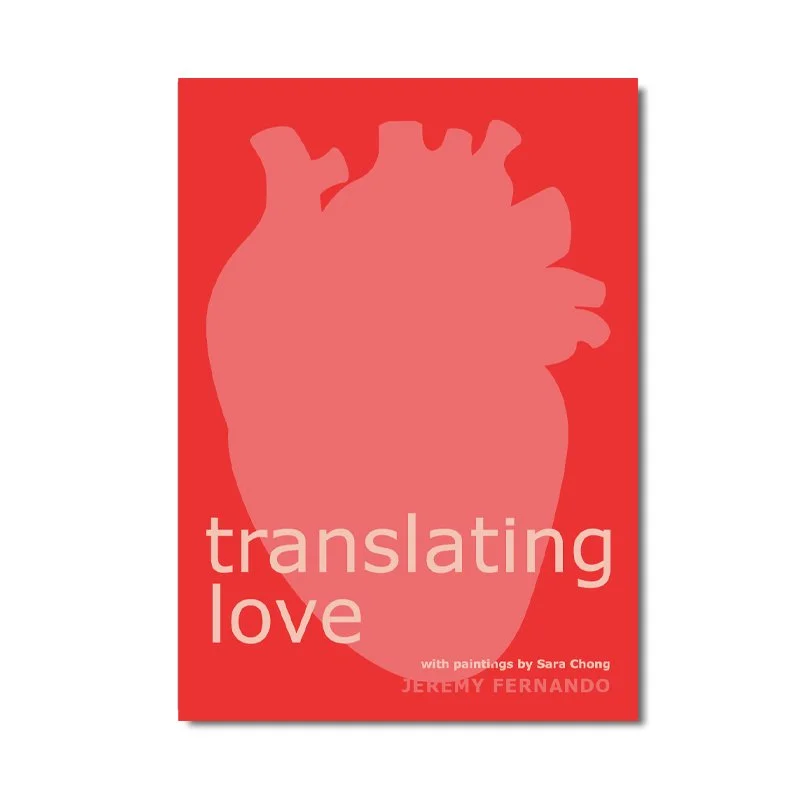
translating love
Contributors
Description
Every translation signifies the space-between, the gap, the historical chasm or the repression of history; translation is the most cautious form of communication since there is always the inherent admission of a certain departure and an uncertain arrival.
~ Hubertus von Amelunxen
To tell a story
is an act of love
~ Chris Kraus
translating love meditates on the possibility that not only is love a fundamental aspect of translation — after all, what even compels one to do something like that, particularly in this day and age where such endeavours barely count in accounting ledgers, hardly register as productive, are often even frowned upon as indulgent — and that there is no love without translation (as all attempts to connect to another entail, or even are, moments of reading), but that translation — being the most sensitive of readings, in which one is opening oneself to the possibility of the text, the possibility of another — and love, whilst not quite the same thing, are potentially inseparable from each other. Which also means translation, even when done out of love, while attempting to have as much care for the text, for another, as possible, always also runs the risk of transforming the text: changing it in ways that might fundamentally alter it, for better or worse.
Where the translator is always also potentially a traitor. Whom (s)he betrays though — the text, herself, the other, their relation — that, that might be the question.
Though, as my dear friend Neil Murphy once told me, 'reading literature with your head is always a mistake'.
So, instead of attempting to rationalise a text — and by extension, reign it in, make it safe, tame it — perhaps all we can do is to open ourselves to a work.
And listen.
And hope that, as Berlin might sing — along with all the risks that it might just — 'take my breath away'
Back cover blurb
To be a good translator, one must be a good listener. One must be able to empty out the ‘self’ and open up to the Other, to the language of the other, the mind of the other. Translation, as Jeremy Fernando knows, is an act of love. Just as reading is. I see myself first and foremost as someone who reads, writes Fernando — and, a little later: [a thought] that has clearly written itself onto me. The writer is a palimpsest, a repository of thoughts received from both teachers (Fernando was a student of the ‘late, great Werner Hamacher’ and of Jean-Luc Nancy) and authors (Blanchot, Genet, Derrida). How fortunate Fernando was, to study with the likes of Nancy and Hamacher, and how fortunate we are, to read Fernando reading them. To us. Through Fernando, we see what it means to read a sacred text, a text that challenges us to discover its secrets. We see what it means to have a thought written into us. We see what it means to open ourselves to the possibility of seeing the world.
~ Charlotte Mandell, literary translator of over 50 books of poetry, fiction, and philosophy, from writers including Maurice Blanchot, François Bizot, Mathias Énard, Jean-Luc Nancy, and Marcel Proust; and recipient of the Chevalier de l’Ordre des Arts et des Lettres (2024), the Thornton Wilder Translation Prize from the American Academy of Arts and Letters (2024), and the French-American Foundation Translation Prize (2017 and 2026)