« Scattered Thoughts and Admiration for ‘Her Name Upon the Strand’ and Other Tammythings: A Partial Retrospective » by Cyril Camus in ‘Cha: An Asian Literary Journal’ (14 August, 2026)
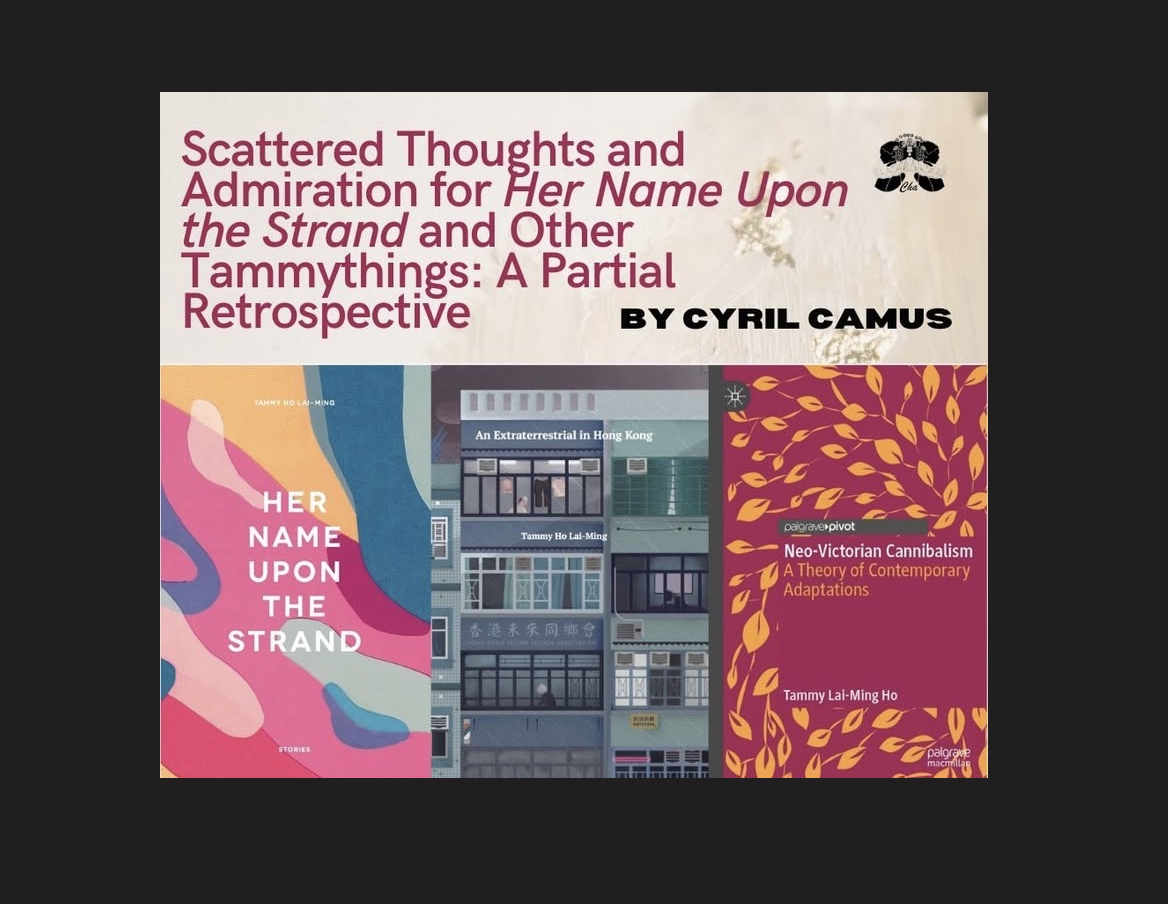
« Blessed times, though, when Tammy Ho did not yet have to devote the entirety of her days to responding to email, and she could actually be the great writer that she obviously is.
A striking testament to this greatness, Her Name Upon the Strand is a delightful patchwork of micro-fragments that are sometimes realist or minimalist, and one never knows to what extent they are autobiographical or resolutely fictional, sometimes Kafkaesque or discreetly surrealistic, along with a few longer texts (some four pages long) in a similar vein.
Among those, I particularly enjoyed “Eyes”, which is a kind of crossover between Saramago’s Blindness and Lucile Hadzihalilović’s Evolution, with a colony of blind children who play quietly, unaware of the fate that awaits them.
I was also struck by two stories about the grandmothers of some of those female narrators who sound possibly autobiographical but not necessarily; perhaps it is some trace, in Ho’s narrative prose, of her usual practice and mastery of meditative, testimonial and intimate poetry. One of the grandmothers, in the story called “Summer”, dies peacefully, and is the object of a soft, pensive narrative focused on the anticipation, and then on the mourning. The other, “Grandma”, is more dramatic. Shortly before her death, the titular elder unveils to her granddaughter the sordid details of her unsuspected, dissolute life, replete with abandoned children and an aborted one. The story focuses on the narrator’s shock at discovering, in someone close to her, an entire reality she could not have imagined.
Among the little gems scattered about in this thin but rich little jewel of a book, this fragment (one of the “Tales of Departure”) also stands out in its subtle use of poetic language (“a lost soul in the sunset of everlasting disappointment”) or images evocative of childlike wonder (“be best friends, sharing […] evil secrets”) to confer an aura of whimsy and quasi-fantasy on a text that is about a very un-phantasmagorical and realistically melancholy anecdote of people lost and found, and others who flee the world and seem to have left no mark, to be missed by no one, despite their good works:
My sister’s friend knows a friend who knows someone whose job was to locate missing people. For a few years, she was confided to many inside stories of moderately rich families and she retrieved teenagers and adults alike from dire and humiliating situations. She enjoyed an odd sense of satisfaction mingled with hatred whenever someone thanked her for unearthing the precise location of a lost soul in the sunset of everlasting disappointment. One day, she was gone. Nobody knew where she went. Perhaps she wanted to be found by someone like herself; and the two of them could be best friends, sharing strategies and evil secrets. But no one seems to care about her enough to take the initiative to consult a detective. And therefore she is free. Somewhere between this world and the next.
Did I mention that the writing and ideas in Her Name Upon the Strand also often show a remarkable sense of humour? It is usually subtler and more deadpan than in the example quoted below, but this fanciful display of “female-Kafkaesque trash” certainly gives a strong sense of how hilarious Tammy Ho can be:
DREAMS
i.
I had a weird dream the other night, possibly inspired by the Brexit vote. In the dream there was a referendum about whether books should be universally banned. In the end, more people voted for the motion than against it, and so the world became officially bookless. In this new order, I belonged to a secret group, very much like in Fahrenheit 451, who memorised texts, and turned ourselves into walking and breathing books. But not all members could choose which books to read and become. And so I was assigned to be porn. And regardless of which members in the secret group came to me to release my book memory, I had to oblige.
Just before, in the collection, there is also a slightly longer story called “Black Me”, which reminds me a bit, in some of its aspects, of Yōko Ogawa’s The Ring Finger, but in a darker tone. This story is particularly captivating, with, again, some flashes of delightfully offbeat humour.
ii.
I had a dream that some might consider sexy. In it, I applied to be a high-end escort and on the application form I ticked “SM possible”. So I was given some training. The male instructor made us watch some SM-inflected porn, and then ordered us to take off our clothes. I noticed that the other women were wet, aroused by what they’d seen. I, instead, found myself bleeding (in reality I was having a heavy period) so I said I am sorry but I cannot go on because it is my time of the month. Upon hearing this, the trainer, beaming, said, “That is great. You and I can do something very special indeed. I will teach you.” I got very scared and uncomfortable, and said that I was suffering great period pain (I was in real life as well). And so I fled, ran as fast as I could out of the training barn and onto the grassland. With each step, my blood stained the white and yellow flowers.
Just before, in the collection, there is also a slightly longer story called “Black Me”, which reminds me a bit, in some of its aspects, of Yōko Ogawa’s The Ring Finger, but in a darker tone. This story is particularly captivating, with, again, some flashes of delightfully offbeat humour.»
~ Cyril Camus
***
to read the full version of Cyril Camus’ « Scattered Thoughts and Admiration for Her Name Upon the Strand and Other Tammythings: A Partial Retrospective », please go to Cha: An Asian Literary Journal, 14 August 2026.
to get your copy of Her Name Upon the Strand, please click here.